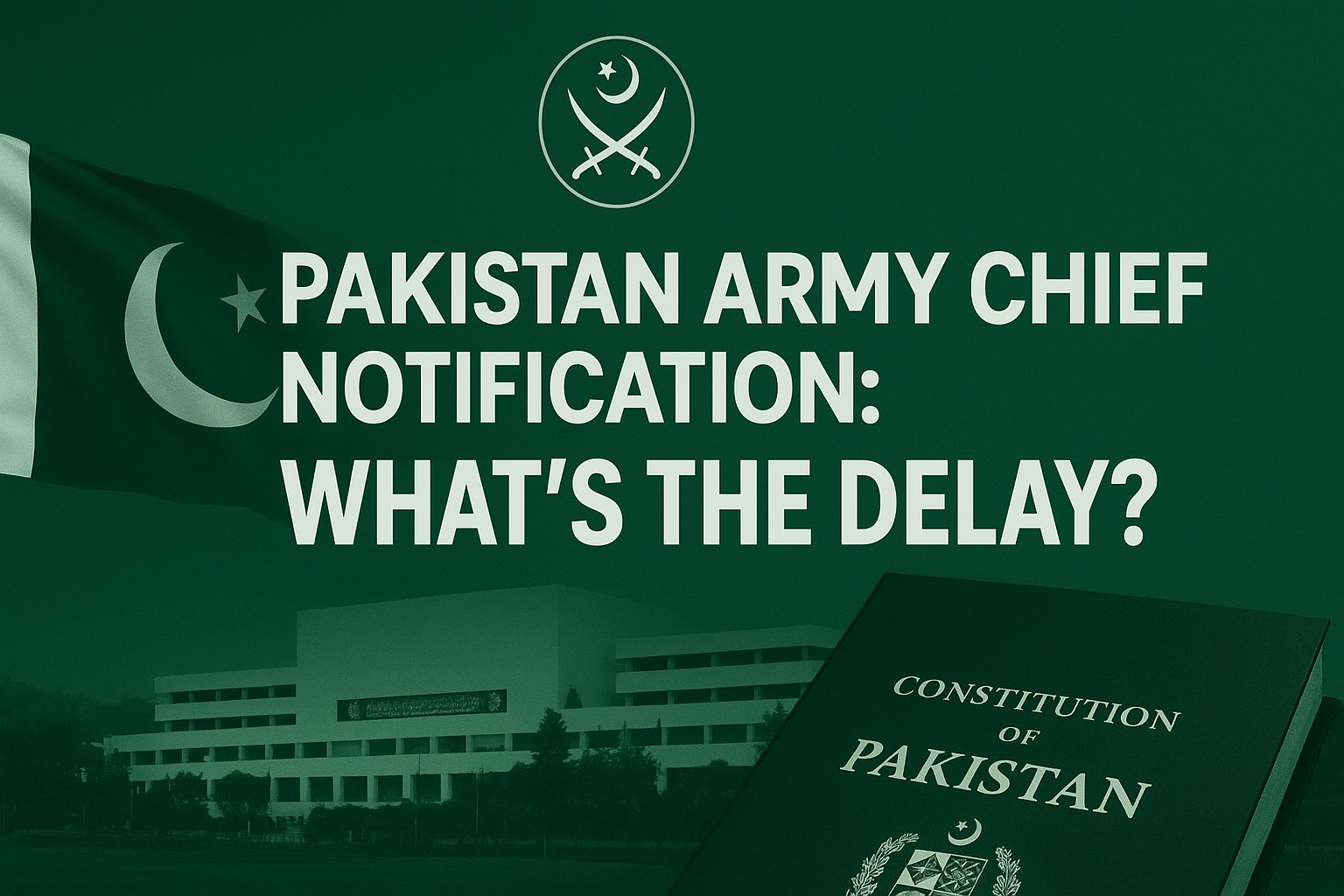
Pakistan Army Chief Notification Delayed: What’s Behind the Controversy?
Imagine the scenario of a nuclear-armed nation going through a tough period of not knowing who, among the military leaders, is in charge of its nuclear power: that was precisely what Pakistan lived during the period when, November 29 came and went with no expected army chief notification. It threw the situation in question and sparked a wave of intense speculation, raised a number of constitutional questions and left a lot observers wondering what exactly is going on in Islamabad behind the closed doors.
If a person follows closely the events in Pakistan politics, he or she would understand that it is not just another case of delay in the government circles. The notification of the army chief of pakistan has become the main point in gaining insight into the power shift in one of the most strategically significant countries in South Asia.
Understanding the Chief of Defence Forces Position
The 27th Constitutional Amendment resulted in the establishment of the Chief of Defence Forces (CDF) position, which absorbed the Chairman Joint Chiefs of Staff Committee Gulf News into his post. Just think of it as a giant reshuffle in the military hierarchy of Pakistan.
So what is the difference this time around? The Chief of the Army has mixed the function of the Chief of Defence simultaneously. Field Marshal Asim Munir who has been holding that post since November 2022 is thought to be the first CDF of Pakistan. However, there is a condition—it needs formal notification.
The appointment effectively gives the army leader control over the air force and navy Al Jazeera, which means a coming together of military strength that has not been witnessed in Pakistan before. The initial three-year term for the service chiefs was raised to five years, and Munir’s reelection will now be in November 2030 according to Arab News PK.
Why November 29 Mattered So Much
November 29 was more than just another Friday. It was the day when Field Marshal Munir’s three-year term as Army Chief dawned. The government was expected to issue a notification combining his role with the new CDF position. Doubts began when that didn’t occur.
I have been following the political scene in Pakistan for a long time, and I feel that this delay is different. It is a matter of paper only; it is about getting the constitution clear in a country where military rule has a big say in all matters.
Some lawyers defined the situation in such a way that without a new notification Munir’s tenure might have been interpreted as already over. Others, however, pointed to law changes indicating that no further notification was required. The confusion? It’s definitely there, and it is important.
The Prime Minister’s Absence Raises Eyebrows
Things are coming to a head, to say the least. Prime Minister Shehbaz Sharif was in Bahrain and then in London when the notification deadline The Tribune passed, which led people’s minds to wonder if his absence was intentional.
Minister of Defence Khawaja Asif tried to pacify the situation. “Please be informed that the process has been initiated. PM is coming back soon. Notification will be issued in due course,” he wrote on social media, as quoted by Dawn.
However, when a government states that something will take place “in due course,” it is understood that the matter is more complex. The timing of Sharif’s medical visit to the UK was very suspicious indeed.
Legal Debates: Does Pakistan Even Need a New Notification?
This is precisely the point where constitutional lawyers begin to diverge in their opinions. Some legal experts are of the opinion that the amendment made in 2024 to the Pakistan Army Act incorporated a “deeming” clause which explicitly stated that the provision “shall always be deemed to have been part of the Pakistan Army Act,” thus leading to an automatic extension of Munir’s term from three to five years according to Dawn.
If that is the case, it could mean that the Army Chief position in Pakistan does not necessitate new paperwork. However, it is important to note that there is a virtually unanimous agreement among security and legal experts that the establishment of the CDF post, which should be considered as a new assignment and not a continuation, does impose the requirement of a formal notification according to Dawn.
It’s akin to getting a promotion at work. Your present position might be safe but the new title? You have to go through the process of getting it documented officially.
What’s Actually at Stake Here
Aside from the legal hairsplitting, Pakistan’s defense structure is surrounded by real issues that need answering. The final answer as to how much control the CDF will have over the Pakistan Navy and Air Force is still not known.
The aspect of the National Strategic Command, which is the nuclear control board of Pakistan, is also under discussion. The Diplomat reports that a newly appointed commander of the National Strategic Command will be in charge of nuclear matters, but this appointment cannot be made until the CDF notification is released.
Just take a moment to reflect on that. The command structure of Pakistan’s nuclear program is under a state of confusion due to the absence of necessary documents.
The Power Consolidation Question
According to ORF Online, the 27th Amendment bestows upon an officer promoted to five-star rank lifelong constitutional protection. Field Marshal Munir was awarded his promotion following India’s and Pakistan’s short military encounter in May 2025.
There is no doubt that this move is about military effectiveness. The detractors claim that the amendment equips the military with a constitutionally fortified position in Pakistan for the first time, thus altering the power dynamics between the civil and military authorities very deeply Himal Southasian.
A part of the story is told by the numbers: The total time that Munir will act as the chief of the army of Pakistan amounts to eight years, until 2030, and the new law affords him a five-year extension Arab News PK. That’s a single person’s potential 13 years of military leadership.
International Reactions and Concerns
Internationally, the delay has not gone unnoticed. A Pakistani government newspaper reported that the UN High Commissioner for Human Rights warned that the “serious undermining of judicial independence” resulted from the constitutional amendments in Pakistan. While the country’s Foreign Ministry dismissed these issues, The Express Tribune published the news.
The situation, for the USA and other Western observers, is a matter of concern regarding the stability of a nuclear-armed country that is situated in the middle of India, Afghanistan, and Iran and is very important from the geopolitical point of view.
What Happens Next
Currently, the government is still saying that the notification for the appointment of the Army Chief of Pakistan is going to be released very soon. The notification is expected to be issued at the time when Prime Minister Shehbaz Sharif comes back to Pakistan, according to Arab News PK.
However, the following significant points still remain in doubt:
Eventually, when will the notification be issued? The government has not given a clear answer and is only saying “in due course of time.”
What will be the official starting date of Munir’s term as CDF? One of the options being debated is whether to consider November 2022 when Munir originally took command or November 2025 as the start of the COAS’s five-year term: Dawn.
How will this affect inter-service dynamics? The secretaries of the Air Force and the Navy are now answerable to an officer from the Army, a change that is likely to generate antagonism.
The Bigger Picture
The delay in notification is a significant indicator of the civil-military relationship in Pakistan and the 27th Amendment has practically legitimized the ‘hybrid civil-military model’ which has been operating since approximately 2018 according to ORF Online.
No matter if you are a policy analyst in Washington, a researcher focusing on South Asian security, or just an interested person wanting to know more about regional dynamics, the appointment of Pakistan’s army chief is important. This issue goes beyond individual, one man or one position; it has to do with the way a nuclear-armed nation of 240 million operates its strongest institution.
The notification will ultimately be issued. When that happens, it will be more than just a matter of formality. It will represent a new phase in Pakistan’s continuous struggle to find the right mix between democracy, military power, and legal rule. And from what I have seen, this tripartite balance keeps changing in a manner that, in my view, is worthy of our constant watchfulness.