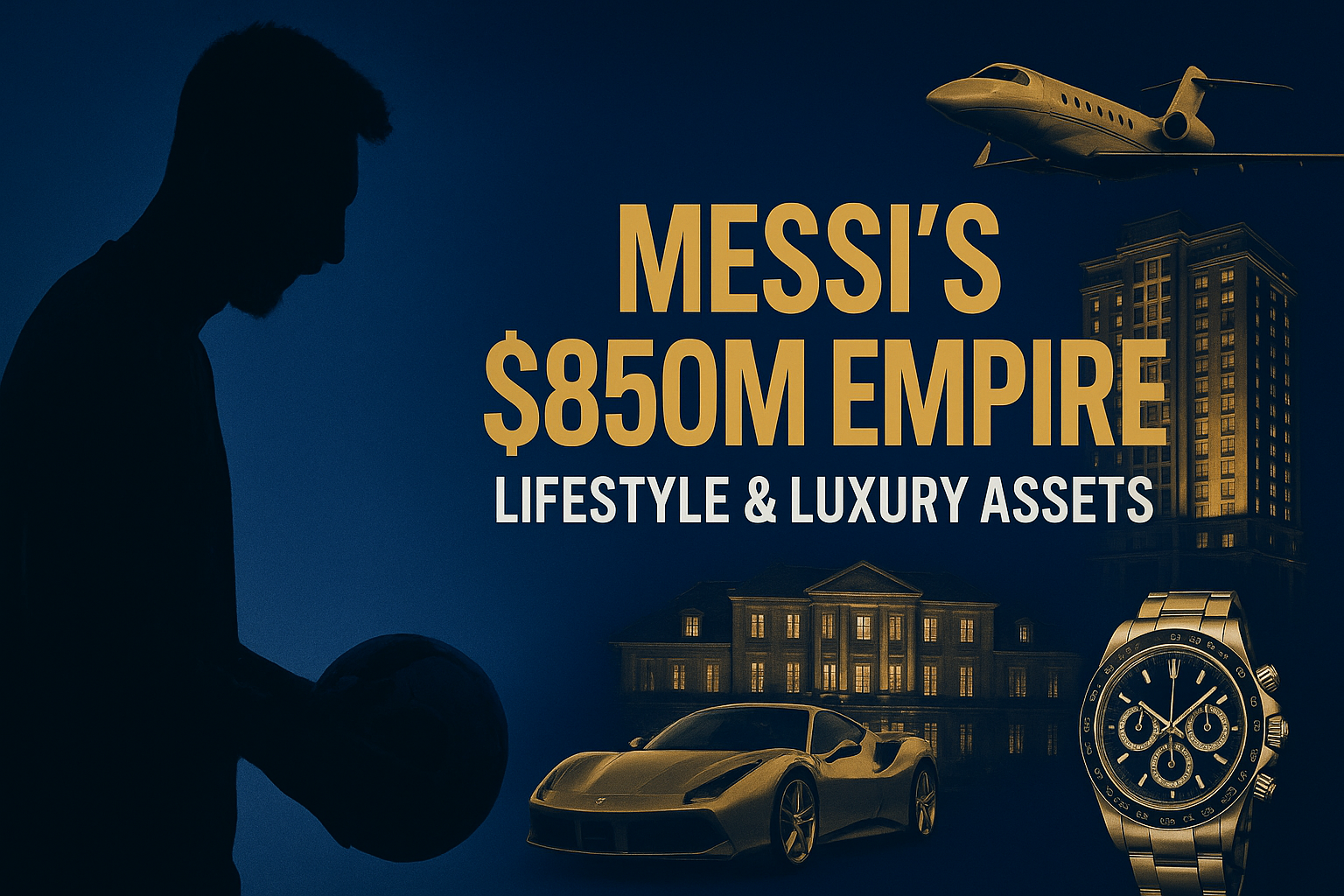
Inside Messi’s $850 Million Empire: The Luxury Lifestyle Behind Football’s Greatest Icon
Ever wonder what happens when you combine eight Ballon d’Or trophies with a lifetime of smart investments? You get a lifestyle that makes even billionaires jealous.
I’ve spent years following Messi’s career, and watching him build his fortune off the pitch has been just as fascinating as his magic on it. While most people know him for bending free kicks and leaving defenders in the dust, the Messi lifestyle and luxury assets portfolio tells a completely different story—one of strategic real estate moves, million-dollar timepieces, and business ventures that’ll keep paying dividends long after his boots are hung up.
The numbers are staggering. We’re talking about a $232 million real estate portfolio, cars that cost more than most people’s houses, and a hotel empire spreading across three continents. But here’s what surprised me most: Messi isn’t just spending his money—he’s multiplying it.
The Real Estate Mogul You Didn’t Know About
When Messi bought his first Barcelona property in 2009 for $2 million, nobody could’ve predicted where it’d lead. That Castelldefels mansion—the one he expanded by literally buying out his noisy neighbor—now sits at $7 million. But that’s just the beginning.
His Miami waterfront estate tells you everything about how the Messi lifestyle and luxury assets game has evolved. The $10.75 million Fort Lauderdale property features eight bedrooms, nine bathrooms, and 170 feet of water frontage. Then there’s the $50 million architectural marvel he purchased in Miami, complete with a three-car garage and every amenity you’d expect from someone earning $96,000 a day.
The Ibiza acquisition might be my favorite. Messi dropped £9.5 million ($12.6 million) on a 20,020-square-foot Mediterranean paradise in 2022. Eight bedrooms, space for 16 guests, and views that’d make you quit your job. He bought it from a Swiss business tycoon, which tells you the circles he’s running in these days.
But here’s the kicker—Messi isn’t just collecting properties like trophies. As chairman of Edificio Rostower Socimi, a Spanish real estate investment trust valued at $232 million, he owns seven hotels through his MiM Hotels chain. These aren’t budget motels. We’re talking luxury boutique properties in Ibiza and the Catalan Pyrenees, managed by the prestigious Majestic Hotel Group.
A Garage That Rivals Most Car Dealerships
Picture this: You’re scrolling through Messi’s garage, and you spot a Ferrari 335 S Spider Scaglietti. “Nice car,” you think. Then someone tells you it’s worth $36 million. Not $36,000—$36 million. That’s the Messi lifestyle and luxury assets portfolio in a nutshell.
His 15-car collection, valued around $6 million (not counting that $36M Ferrari), reads like a supercar enthusiast’s dream wishlist. The Pagani Zonda Tricolore alone costs $1.6 million. Ferrari F430 Spider? $164,490. Mercedes SLS AMG with those iconic gullwing doors? $642,490.
What caught my attention was the practicality mixed in with the excess. Sure, he’s got Maseratis and Ferraris, but he also rolls around in two Range Rovers—the Vogue ($200,000) and the Sport ($69,500). Even legends need a comfortable daily driver.
During his Barcelona days, Audi hooked him up with a trio: RS6 ($108,000), A7 ($69,200), and Q7 ($54,590). Not a bad company car package.
Wrist Game Worth More Than Your House
I’ll admit it—I used to think expensive watches were just status symbols. Then I saw Messi’s collection and realized these are legitimate investments. Some pieces appreciate faster than real estate.
The crown jewel? A Patek Philippe Nautilus 5711/1A-018 “Tiffany Blue” edition. Only 170 were made. It retailed at $52,000. One sold at auction for $6.5 million. Messi got his through private channels right after release.
His Jacob & Co. Epic X Chrono Messi—a $128,000 timepiece designed specifically for him, limited to 180 pieces—features Argentina’s flag colors and his famous number 10 highlighted in red. When you’re designing your own watches, you’ve officially made it.
The Rolex collection deserves its own article. When he signed that $80 million PSG contract, Messi showed up wearing a rose gold Yacht-Master 126655 ($27,300 retail). For his 34th birthday, he treated himself to a Submariner “Smurf” in white gold with a bright blue bezel—one of the rarest Rolexes out there.
His Patek Philippe Grand Complications 5531R is valued at $9 million. Just let that sink in. Nine million dollars. On your wrist.
The Private Jet That Makes Commercial Flying Irrelevant
In 2018, Messi dropped $15 million on a Gulfstream V private jet. The exterior features his famous number 10, and inside? Pure luxury. When you’re earning what he earns and traveling as much as he does, commercial flights become impossible anyway.
Add in the yacht charters—like the Seven C, a 28-meter beauty he’s been spotted on with Luis Suarez and Cesc Fabregas. Available for £38,000 per week (basically pocket change when you’re making $54 million annually at Inter Miami), it sleeps ten guests across four cabins and comes with Waverunners, kayaks, and paddleboards.
The Business Moves That Separate Legends From Icons
Here’s where the Messi lifestyle and luxury assets portfolio gets really interesting. The football ends eventually, but smart investments last forever.
His Mas+ hydration drink venture sold $200 million in 2024—its first year. Let that sink in. Messi Fragrances launched in 2025, tapping into the billion-dollar celebrity fragrance market. The Play Time Investment Fund backs sports, media, and tech startups through his Silicon Valley-based family office.
The Saudi Arabia tourism ambassador deal? $25 million over three years. His lifetime Adidas contract, structured similarly to Cristiano Ronaldo’s Nike deal, is valued north of $1 billion spread over decades. Every jersey with his name on it—and Inter Miami broke U.S. single-season sales records—means royalty checks.
His brand endorsements read like a Fortune 500 lineup: PepsiCo, Budweiser, Mastercard, Gatorade, Gillette, Hard Rock. Combined, they bring in another $35-$45 million annually.
The Rosario Roots He Never Forgot
Despite the yachts and Ferraris, Messi invested heavily in his hometown. The Azahares del Paraná housing development in Rosario wasn’t just about profit—it was about giving back. Same with the luxury condominium tower he funded there.
His Leo Messi Foundation, established in 2007, focuses on education and healthcare. When you’ve got 500 million Instagram followers and influence that spans continents, using it for good matters.
What Makes Messi’s Approach Different
I’ve covered plenty of athletes who blow through fortunes. What separates Messi is the strategy. He’s not buying assets that depreciate—he’s building an empire that generates passive income.
The hotel chain will operate long after he retires. The real estate appreciates. The watches become more valuable. The business ventures create multiple revenue streams. His $850 million net worth in 2025 isn’t just from football contracts—it’s from thinking like a CEO while playing like a god.
Every investment ties back to stability. No high-risk crypto gambles. No pyramid schemes. Just solid, proven sectors: hospitality, real estate, sportswear, endorsements.
The Miami Effect
Moving to Inter Miami wasn’t just about extending his career. The lifestyle Miami offers—balanced family environment, business opportunities, and warm weather—aligned perfectly with his next chapter. He transformed Inter Miami into a global brand overnight. Club valuation skyrocketed. MLS got European, Asian, and Latin American eyeballs.
His presence attracted new investors, sponsors, and young players to the league. He proved elite talent can thrive outside Europe’s big leagues while building wealth in America’s business ecosystem.
Living Legacy
The Messi lifestyle and luxury assets collection isn’t about showing off—though that $36 million Ferrari certainly turns heads. It’s about building something that outlasts the goals and trophies. When he finally walks off that pitch for good, the hotel empire will still operate. The real estate will still generate income. The brands will still cut checks.
That’s the genius move everyone overlooks while focusing on his left foot. Messi studied the playbook of athletes who stayed wealthy versus those who went broke. He hired the right advisors, made conservative investments, and built multiple income streams.
His approach mirrors his playing style: calculated, precise, and devastatingly effective. Whether it’s bending a free kick or building wealth, Messi makes it look effortless. But behind every asset is careful planning, smart advisors, and the discipline to think decades ahead.
The watches alone could fund most people’s retirement. The car collection represents automotive art. The real estate portfolio generates passive income forever. And those endorsement deals? They’ll keep coming as long as he stays visible, and with 500 million Instagram followers, visibility isn’t an issue.
The Numbers Don’t Lie
Let’s break down the empire: $850 million net worth, $40 million in global real estate, $6 million car collection (plus that $36M outlier), $60 million in lifestyle assets including watches and art, $232 million real estate investment trust, and annual off-field income of $50-$70 million.
When you look at the complete picture of Messi lifestyle and luxury assets, you’re not just seeing a footballer who made money. You’re seeing a businessman who happens to play football at a level nobody else can match. Every luxury purchase is strategic. Every investment calculated. Every move designed to build generational wealth.
That’s the real difference between good and great. Messi didn’t just dominate on the pitch—he’s winning off it too, and that game never ends.