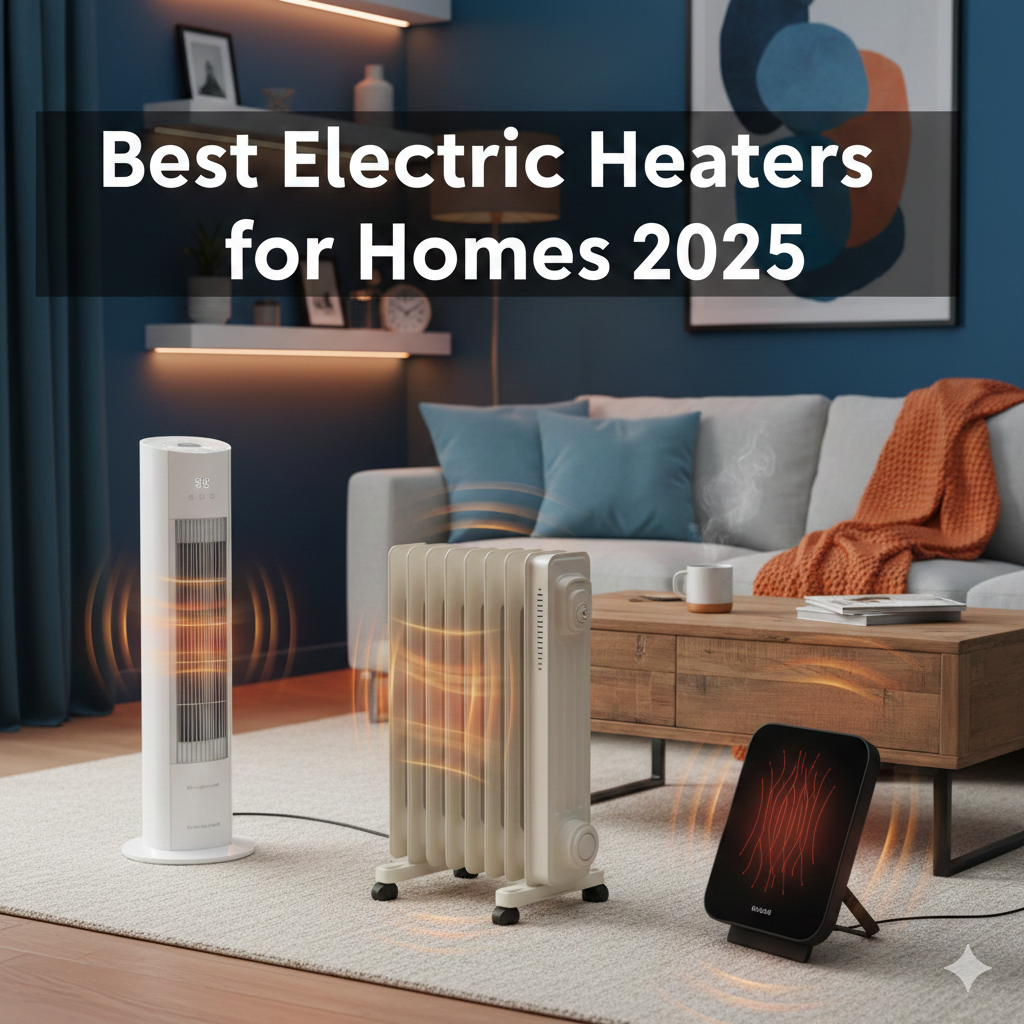
Best Electric Heaters for Homes: Your Complete 2025 Buying Guide
Winter has rolled in, and my living room has turned into a freezer zone. After three years of enduring cold February mornings, I have finally had enough and decided to do something about it. What I learned during my search for a heater was quite shocking, and it will probably save you from the mistakes I did.
Choosing the best electric heaters for residential usage is not simply a matter of taking the first model you come across at the hardware store. It is rather a matter of figuring out which type would truly work for your area, your finances, and your heating needs. Whether you want to heat up a very cold bedroom or just want to add some heat to your main heating system, the right electric heater can make winter tolerable without putting a huge dent in your electricity bill.
Why Electric Heaters Beat Central Heating for Targeted Warmth
There’s something that most people are not aware of: heating the whole house just to make one room comfortable is very much like burning all the bulbs just to get light for reading a book. The primary advantage of electric heaters is the zoning of heating that means heating is done only for the area that you are occupying.
I want to share my experiment with this theory last winter. I used a $65 ceramic heater for my home office and managed to keep it at 68°F while the thermostat was set at 62°F. The outcome? My heating bill that month was about $40 less than usual. The savings were not mind-blowing, but certainly noticeable.
The best electric heaters for indoor use are also instant heaters, no waiting 20 minutes for the furnace to turn on. Just flip the switch, and you are warmed up in a matter of seconds.
The Three Types That Actually Matter
Walk into any store and you’ll see dozens of models. But they all fall into three main categories, each with distinct advantages.
Ceramic Heaters: Fast Heat for Small Spaces
Ceramic models utilize PTC elements (Positive Temperature Coefficient) that produce heat almost instantaneously. On the days that I require my bathroom to be heated before taking a shower in the morning, my ceramic heater heats the room in approximately five minutes.
Generally, these heaters are equipped with a fan that circulates warm air inside the room. The drawback? That fan is noisy—not as loud as a jet engine, but still quite audible if you are trying to sleep or focus. In most cases, ceramic heaters will cease to emit heat the moment they are switched off.
Ideal for: Bathrooms, home offices, and any area where you want warmth quickly and you do not mind the noise from the fan.
Oil-Filled Radiators: Silent and Steady
Imagine a traditional radiator but replaced thermally conductive oil for water instead. The electric elements warm up the oil, which then gives off heat to the room.
Radiator heaters take longer time heating up—generally 15-20 mins before a noticeable difference is felt. But they are very hot and still very hot for hours even if you have turned them off. The heat kept means that they do not cycle on and off as often as they could, hence, electricity is potentially saved over the long heating period.
The most plus point? Total silence. Absence of a fan translates to no noise, thus they are ideal for bedrooms.
Ideal places are: Bedrooms, living rooms, and wherever you require heat that is quiet and consistent for several hours.
Infrared Heaters: Direct Heat Like Sunlight
Infrared heaters are a different story when compared to ceramic and oil-filled models. They do not heat up the air around them but rather produce infrared rays that heat directly the people and objects—just like the sun warms your skin on a chilly day.
This feature gives them an upper hand over the other types of heaters in the area of spot heating. If you are at your desk, an infrared heater directed at you will make you feel warmer in no time compared to heating the whole room. But if you shift the position so that you are not directly opposite the heater, the warmth will be gone.
Best for: Workshops, garages, and places where you rather want to have concentrated heat on a particular spot than the whole room being warmed.
What I Learned From Testing Five Different Models
Over three months last winter, I rotated through five heaters across different rooms. Here’s what actually mattered beyond the marketing hype.
Size Matching Matters More Than Wattage
The 1,500-watt ceramic tower I purchased? Absolute overkill for my 100-square-foot bathroom. In contrast, the same wattage hardly affected my 300-square-foot living room at all.
The rule of thumb laid down by the majority of manufacturers is 10 watts for every square foot. In other words, a bedroom with the area of 150 square feet requires approximately 1,500 watts. However, in addition to that, you should consider the height of the ceiling, the quality of insulation, and the number of exterior walls (which are the ones that draw heat away).
Safety Features You Actually Need
I became obsessed with tip-over protection after almost tripping over my heater at two in the morning. This function cuts off the unit automatically if it gets turned over—very important if kids, pets are around, or if you are just clumsy like me. Overheat protection is the other must-have. Good heaters have sensors that kick in and shut down the unit before the internal parts get to the dangerous temperature. According to Consumer Reports’ testing, they found several inexpensive models that did not have this basic safety feature and scored very low on their hot-surface tests.
The Remote Control Debate
I used to think remote controls on heaters were unnecessary luxury features. Then I bought a unit without one.
Here’s the reality: safety experts recommend keeping heaters on the floor, not on tables or furniture. That means bending down every time you want to adjust the temperature. After doing that twenty times a day for a week, I paid extra for a model with a remote and never looked back.
Top Picks Based on Real-World Testing
The best electric heaters for home use depend on your specific situation, but these models consistently outperform in Consumer Reports testing.
Overall Champion: Honeywell Models
Honeywell heaters achieved the highest ratings in tests for both heating a room and heating a spot. They are quite capable of warming up a standard room of 204 square feet effectively and simultaneously giving off direct warmth to the nearby persons. The majority of models come with tip-over protection, overheat sensors, and thermostatic controls as standard features.
Price range: $40-$120
Quick Heat Winner: Lasko Ceramic Tower
Lasko’s ceramic tower heaters are known for their ability to heat up rooms quickly. They were tested in such a way that they got to pleasant temperatures in less than 15 minutes. The oscillating function also aids in spreading the warmth more uniformly compared to non-moving models.
What is the downside? They are noisier than oil-filled heaters and require continuous fan operation.
Price range: $50-$90
Silent Operation: DeLonghi Oil-Filled Radiators
When it comes to bedsoms, there is no better choice than DeLonghi’s oil-filled radiators. The almost complete silence of their operation is characteristic—only the soft click from the thermostat cycling from time to time. Reports find that they hold comfortable temperatures very well without the constant on-off cycling that disturbs very light sleepers.
They are heavier than the ceramic models (20-25 lbs in average) and take more space on the floor.
Cost: $70-150
Budget Option: Comfort Zone Basics
The Comfort Zone brand produces low-priced ceramic heaters that were still able to deliver an acceptable performance in tests even though they were priced below $40. No, you will not be able to have any sophisticated functions like WiFi connection or exact digital thermostats, but you will at least enjoy heating with minimal safety features.
Ideal for usage in areas that do not need uninterrupted heating from time to time.
Price level: $25-$60
Common Mistakes That Waste Money
After talking to dozens of people about their heater experiences, certain mistakes kept appearing.
Buying Based on BTU Claims Alone
Irrespective of their kinds, each 1,500-watt electric heater generates an approximate 5,100 BTUs. The companies that claim “30% more efficient heating” or “ceramic technology heats faster” are very often deceiving you. The watts determine the heating ability while the technologies used do not contribute to it directly.
Heater types do differ in their heat distribution, retention period, and the time taken to shut off.
Ignoring Your Electrical Setup
The maximum power output of standard home electrical outlets is guaranteed to be 1.5 kW. If you connect two heaters to one circuit, it will automatically reset your breaker as a safety precaution. I discovered this the difficult way when I set up on the same circuit heaters in adjoining rooms.
Before purchasing more than one unit, it is wise to verify the electrical capacity of your house. It might be worth having an electrician put in separate circuits if you are thinking of heating to a great extent with the help of add-on heaters.
Expecting Whole-House Solutions
Electric heaters are excellent for providing supplementary heating in a particular area, but they are not good at all for replacing the main heating system. The electric power bills might go sky-high, and most of the heaters are not made for continuous operation throughout the day and night.
If you use them properly—heating the rooms that are occupied and setting the thermostat of your main heating system lower—you will get better results than using them exclusively for heating.
Energy Efficiency Reality Check
Using the best electric heaters for home heating does save money, but the truth is not clear-cut. The cost for 8 hours of operation of a heater with a power rating of 1,500 watts is between $1.20 and $1.50, subject to the electricity rates in your area. If this heater enables you to set your thermostat 5-7 degrees lower, then it could lead to saving some money. But if you are running several heaters and at the same time keeping the thermostat settings at the normal level, your utility bills will go up.
The real savings are from the well-thought-out use: heating only the rooms that are occupied, switching off the heaters when you leave a room, and using programmable thermostats to control heating so that it is not done unnecessarily.
According to Consumer Reports, oil-filled heaters, although they take longer to warm up at first, usually consume less electricity in total over the whole period as their heat retention lowers the cycling frequency.
Smart Features Worth Paying Extra For
Modern electric heaters include various tech features. Some actually improve functionality; others are marketing gimmicks.
Programmable Thermostats: Worth It
The power of setting precise temperatures and heating schedules changed the way I used my heating machines. The device in my bedroom is set to start heating half an hour before I sleep and it turns off at midnight. Forgetting to change the settings manually is no longer an issue.
WiFi Connectivity: Maybe
Using smartphone applications to manage heaters is a convenience but still the majority of users just set the thermostat and forget it. Only in the case of being out of the house a lot or wanting to control the heating remotely would one need such a feature, for example, heating the office before one arrives.
Eco Modes: Actually Useful
Eco modes optimize power consumption by intelligently cycling the heater. In testing, units with effective eco modes reduced electricity use by 10-15% without noticeably impacting comfort.
Oscillation: Depends on Room Layout
Oscillating heaters distribute warmth more evenly across larger spaces. In my rectangular living room, oscillation made a significant difference. In my square bedroom, not so much.
Installation and Placement Tips
Where you place your heater is almost as important as the model you choose.
Prevent heaters from getting closer than three feet to anything combustible like curtains, furniture, and bedding. This is not a matter of being overly cautious; it is founded on real fire safety data. Consumer Reports conducted tests which showed that the heat on the outside of some units is enough for the fabric nearby to catch fire.
Heaters should be put on flat and hard grounds, not on carpets or rugs where they could easily fall. The earlier mentioned tip-over sensors? They will function only when the device is able to tip freely.
For rectangular rooms, place heaters close to the center of the longest wall for the best efficiency. Corners in square rooms often are better places since the heat can spread out more evenly.
Maintenance Keeps Them Running Safely
Electric heaters, in contrast to furnaces that need to be serviced annually by a professional, do not require much maintenance. However, even a lack of basic care can result in their early aging.
In the case of heavy usage, unplug the heaters and dust them on a monthly basis. The presence of dust reduces the performance of the heaters and, at the same time, creates fire hazards. Gentle brushing or vacuuming with an attachment on the exterior grilles is the recommended method.
Check the power cords on your heaters from time to time for any signs of damage, fraying, or overheating near the plug. Cords that are damaged are a serious risk for fire; therefore, if you notice any problems, replace the entire unit.
Heaters should be stored in ventilated dry places during their off-season. Even when the heaters are not in use, moisture can cause damage to the electrical parts.
Making the Final Decision
Determining which the best electric heaters for home usage is, essentially, the process of matching the suitable heater type with your peculiarity.
Do you wish to have rapid heating in a small room that you use only now and then? then the ceramic heaters will do it.
Would you like a hushed, even heating for long periods? The oil-filled radiators will be a good choice.
Are you planning to heat just yourself and not the whole room? Then, the infrared models will be the right ones.
However, whichever you pick, make sure you give priority to safety features over sophisticated technology. A heater that has a dependable tip-over and overheat protection is more important than one that possesses Wi-Fi and 47 different settings.
Get started with one good quality unit and check its performance in your room prior to buying more heaters. What suits flawlessly in your bedroom might let you down in your living room—room size, insulation, and usage patterns are the factors that influence results.
The best electric heaters for home heat are not about picking the most expensive or feature-completed model. Rather, they are about choosing the right type for your room, using it in a smart manner, and keeping it well. If you do that, you will be warm throughout winter without your electricity costs going sky-high.